
Share on
To address environmental challenges, decarbonization is now essential in all sectors of activity.
Transportation, the second largest source of CO2 emissions worldwide (behind electricity generation), is particularly affected. In recent years, air transport has made some progress in this area, but greenhouse gas emissions are still too high, and there is an urgent need to find viable solutions to decarbonize the sector in a sustainable manner.
Éric Schulz, a consultant and former senior executive in the aviation industry, and Jean-Michel Schulz, a professor of aerospace technologies and specialist in cryogenics and aerospace composites, have been looking into this issue. In 2020, they created the start-up SHZ Advanced Technologies to focus on hydrogen aircraft technologies. Used in gaseous or liquid form, as jet fuel or in a fuel cell powering electric motors, dihydrogen may be the key to a successful transition to carbon-free aviation.
The advantage of hydrogen lies in its high energy density, which is up to four times greater than that of kerosene. However, it has a very low density, particularly in gaseous form (approximately 42 kg/m3 at 700 bar), but also in liquid form (71 kg/m3 at atmospheric pressure), which is almost 12 times less than kerosene. As a result, for an equivalent amount of energy, it requires three times more storage volume than kerosene. In addition, liquid hydrogen must be stored at a temperature of -253°C, which further complicates its transport. SHZ Advanced Technologies offers innovative solutions to overcome these difficulties.
Lighter and less bulky tanks
At ambient temperature and pressure, it would take 11 m3 to store 1 kg of dihydrogen! It is therefore unthinkable to store it under these conditions. Liquefying it at a temperature of -253°C appears to be the best option. But cryogenics is not without its dangers: if the fluid warms up, it gasifies and thus occupies a larger volume—which causes a sharp rise in pressure that can lead to explosion. There are currently effective and safe cryogenic storage solutions, but they are generally used on the ground (which removes the constraints of volume and weight) or in space (which is not subject to the same constraints of efficiency and durability).
For the aerospace industry, the challenge lies in developing lightweight, secure cryogenic storage and transfer systems with perfect thermal insulation (to limit evaporation) and minimal impact on payload (i.e., passenger numbers). SHZ Advanced Technologies presents a concept for an integrated liquid hydrogen storage and distribution system that meets all of these criteria and is particularly well suited to regional and medium-haul aircraft, as well as long-haul aircraft.
Existing tanks are cylindrical and have very thick walls, which increases their weight and, given their size, requires them to be installed at the rear of the cabin, to the detriment of passengers. SHZ Advanced Technologies has devised a patented technical solution that neutralizes the compression and shear stresses on the outer shell while maintaining a vacuum. This technique makes it possible to design lighter tanks, which do not necessarily have to be cylindrical, and can be integrated into confined spaces such as wings or cargo holds.
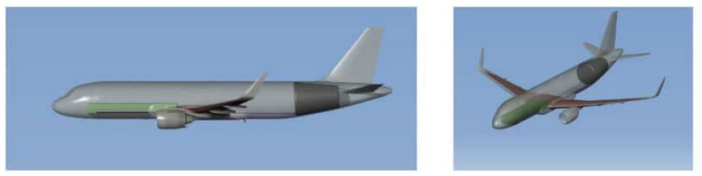
The company proposes using part of the forward cargo hold to store a semi-cylindrical hydrogen tank—a solution that allows for optimal centering of the aircraft throughout its flight phase. In addition, there is a second tank located at the rear, shaped like a truncated cone. Both are connected to a tank located in the central fuselage, which also supplies the two slimmer wing tanks, which are themselves connected to the engines. A secondary circuit system allows direct transfers between the different tanks.
The layout of the various tanks provides good aircraft stability thanks to better weight distribution (compared to other approaches involving tanks located only at the rear of the aircraft). While this solution limits cargo volume by occupying all or part of the forward cargo hold, it allows for more than 94% of the passenger capacity of the same aircraft in its kerosene version.
A cryogenic device under close surveillance
The other system patented by the start-up consists of a double inner shell: the tank containing the liquid hydrogen is itself enclosed in a tank containing pressurized inert gas (helium). Thus, in the event of a leak in the hydrogen tank, it is the helium that would migrate toward the hydrogen and not the other way around. Not only does this helium-filled gap make the system safer, it also keeps the liquid hydrogen at a low temperature. Finally, when all the hydrogen has been used up, the helium replaces it in the inner tank to maintain overpressure; it is then recovered and reused when the tank is refilled.
The company has also designed a damping system that limits vibrations—caused by the aircraft’s kinematics and fluid transfers—experienced by the tank. To keep the hydrogen in a liquid state, SHZ Advanced Technologies relies on the evaporation process, which acts as a natural thermal regulator: the fluid’s temperature remains stable as long as part of it remains in liquid form. Hydrogen vapors are recovered via a circuit that redirects them to the aircraft’s engines when it is in operation; otherwise, they are evacuated through a secure exhaust system. If any incident were to cause a rapid increase in the amount of gas, either in flight or on the ground, SHZ Advanced Technologies has developed a patented rapid purge system that allows it to be safely evacuated.
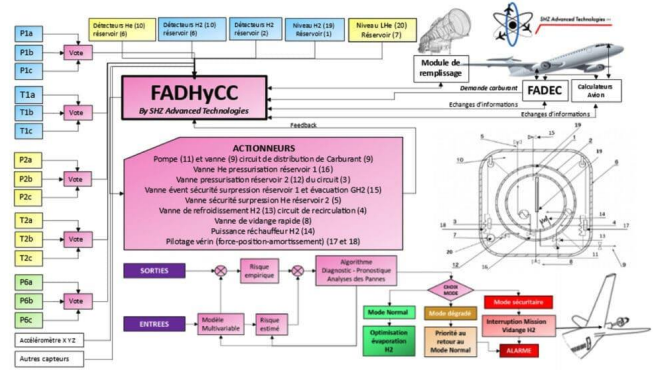
The fuel distribution system consists of insulated, flexible pipes with high thermal performance thanks to a self-supporting, vacuum-insulated structure. Regulating the cryogenic system requires very specific monitoring, as any accidental heat input could cause a rapid increase in pressure; a cryogenic fluid leak would be just as dangerous. SHZ Advanced Technologies has therefore invented a control system called FADHyCC (Full Authority Digital Hydrogen Cryogenic Control), which controls the installation using independent channels, both in flight and on the ground—including during the critical filling and maintenance phases.
Innovations applicable to all modes of transport
After a comparative performance study, converting a conventional kerosene-powered aircraft to a hydrogen-powered aircraft is much more advantageous with the architecture proposed by SHZ Advanced Technologies than with the “standard” configuration (involving two Dewar-type hydrogen tanks located at the rear of the aircraft).
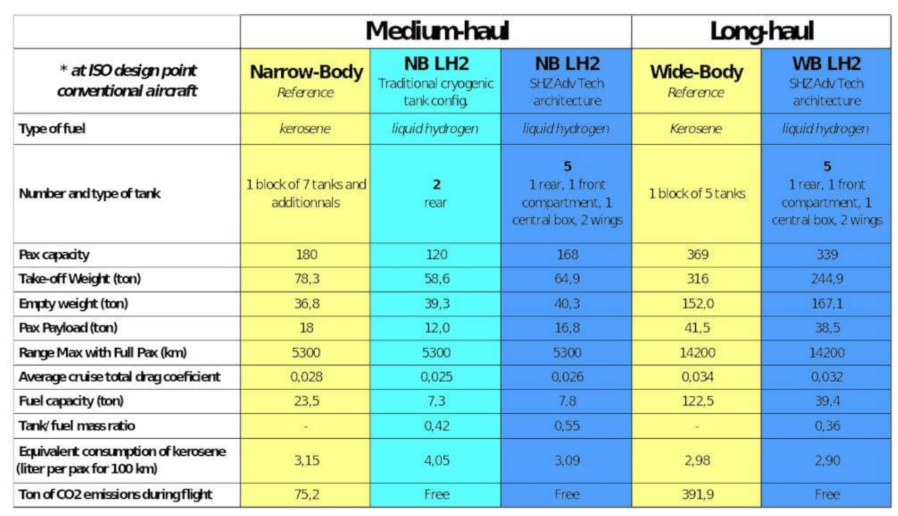
An aircraft converted using the technologies described here offers less cargo volume than the standard cryogenic solution, but can carry almost as many passengers as the original aircraft (168 vs. 180 for a conventional aircraft in the case of a medium-haul flight). Data shows that a long-haul version of a hydrogen-powered aircraft with the same architecture has comparable operational efficiency (with a passenger capacity equivalent to 92% of that of a kerosene-powered aircraft
).
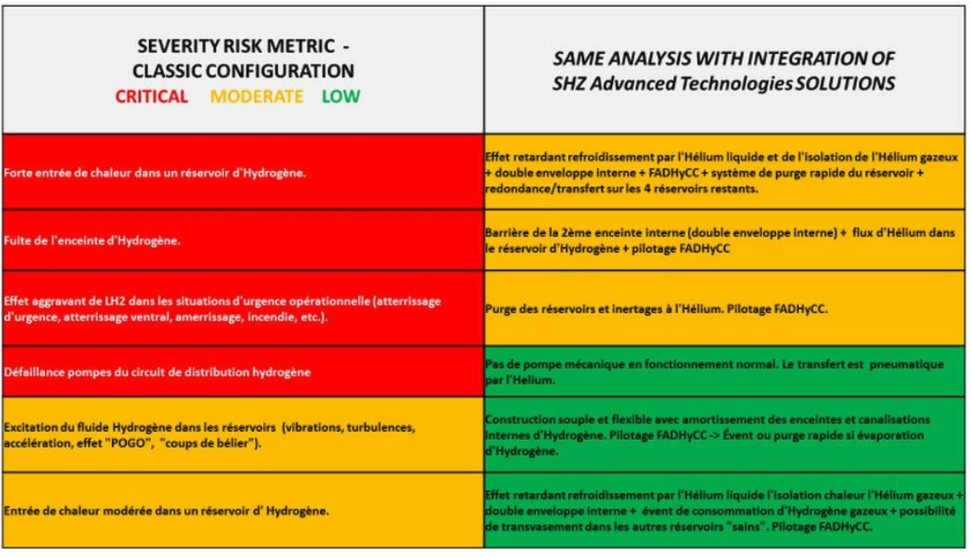
These innovations have also been designed to significantly reduce the risks associated with the presence of liquid hydrogen on board the aircraft. We have already mentioned that the double shell of the tanks and the presence of helium contribute greatly to the safety of the system, particularly in emergency situations, by limiting temperature rises and hydrogen leaks. Similarly, the damping system protects the fluid from vibrations and other turbulence. The fact that hydrogen distribution is based on pneumatic transfer (rather than pumps) also prevents any incidents related to mechanical failure.
Combining performance and safety, all of the innovations offered by SHZ Advanced Technologies make hydrogen-powered aircraft a viable and sustainable development in civil aviation. But this design effort is not limited to air transport: these hydrogen storage and distribution solutions can be adapted to the entire transport sector (automotive, heavy goods vehicles, naval, and rail).


